Solar Panel Payback Calculator
Estimate how many years a home solar system takes to pay for itself from its size, cost, yearly yield, self-consumption and your electricity and export prices.
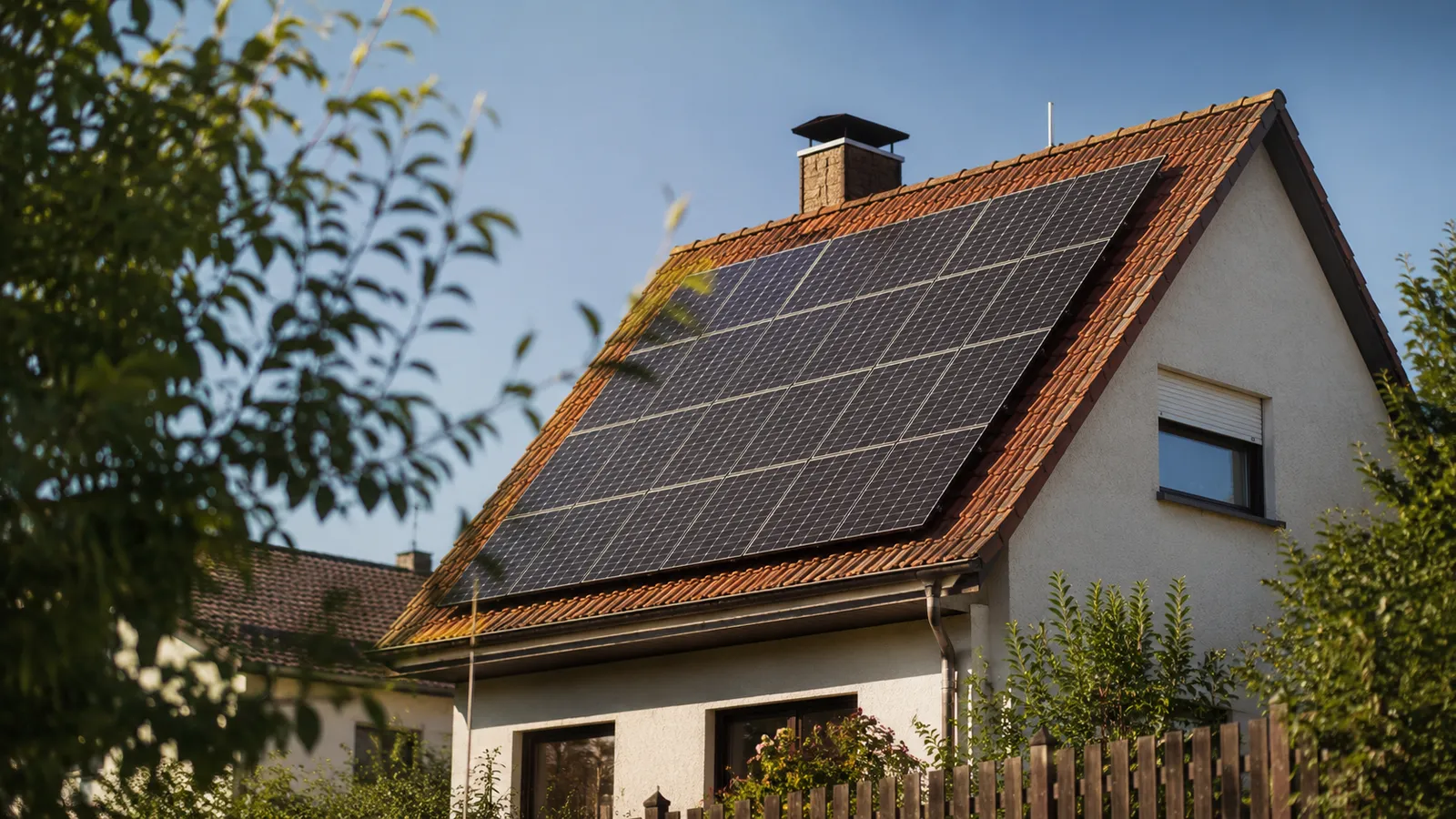
Solar panels are an upfront cost that pays back over years of lower bills. Enter your system size and price, its expected yearly output, how much you use directly, and your electricity and export prices to estimate the payback time.
Solar payback calculator
Pays back in
- Saving / year
- Generation / year
- Self-used / year
Higher self-consumption means faster payback.
How the math works
Each year, solar you use yourself saves the full retail price; solar you export earns the (lower) export price. Annual saving is generation × (self-use% × price + export% × export price). Payback is your total cost divided by that yearly saving.
Worked example: a 5 kWp system at 1,400 kWh/kWp generates 7,000 kWh a year. At 60% self-use, 4,200 kWh save $714 at $0.17, and 2,800 kWh exported earn $168 at $0.06 — about $882 a year. A $7,000 system pays back in roughly 7.9 years.
Assumptions and limits
This is a simple payback: total cost ÷ annual saving. It does not model panel degradation (~0.5%/year), a likely one-off inverter replacement, maintenance, price inflation or the time value of money — all of which shift real payback. Yield depends heavily on location, roof orientation and shading; use a local solar estimate for a tighter number, and be realistic about self-consumption.
When this calculator helps most
This is a first-pass sanity check before getting an installer quote, not a substitute for one — use it to see whether a quoted price and generation estimate are in a plausible range before you commit, and to compare two competing quotes with the same assumptions applied to both.
Mistakes that throw off the estimate
The most consequential mistake is assuming 100% self-consumption. Without a battery, you can only use solar power while the sun is actually generating it, and most homes are empty or drawing very little during the sunniest hours of a weekday. A realistic self-consumption figure without a battery is usually 30–50% for a home that's out during the day, rising towards 50–70% with a well-sized battery. Overstating this number is the single most common way solar payback estimates end up wildly optimistic.
What happens after payback
Payback time is when a system has earned back its cost, not when it stops producing value — most home solar systems keep generating for 20–30 years, with output declining only gradually (roughly 0.5% a year). A system that pays back in 8 years but is warrantied for 25 spends the majority of its working life generating pure savings rather than "paying off" anything, which is worth keeping in mind when payback looks long next to a system's expected lifetime: an 11-year payback is a poor result on a 12-year system, but a good one on a 25-year system. If you're comparing quotes, check the manufacturer's warranty term for both panels and inverter alongside the payback figure, not the payback figure alone.
What it costs in practice
Yearly value of what a solar system generates, by size and how sunny your area is, counting 55% self-consumption (no battery) at $0.17/kWh.
| System | 1,000 kWh/kWp | 1,300 kWh/kWp | 1,600 kWh/kWp |
|---|---|---|---|
| 3 kWp | $281 | $365 | $449 |
| 5 kWp | $468 | $608 | $748 |
| 8 kWp | $748 | $972 | $1,197 |
Your own price and habits change these — the calculator above uses your numbers.
Frequently asked questions
What is self-consumption and why does it matter?
It is the share of your solar output you use directly instead of exporting. Self-used solar offsets the full retail price you would otherwise pay, while exported energy usually earns much less.
What yearly yield should I assume?
It depends on location and orientation, but 900 to 1,600 kWh per kWp per year covers most of Europe and North America. Local solar calculators or an installer can give a tighter figure.
Does this include maintenance and degradation?
No, this is a simple payback based on annual savings. Panels lose roughly 0.5 percent output per year, and inverters may need replacing once, which lengthens real payback slightly.